The Difficulty Ratio
A fundamental principle in SaaS sales is that the size of a deal must be large enough to justify the effort required to close it.
**David Sacks and Brian Murray**
Apr 01, 2023
There are many ways to win in SaaS. Some software companies target enterprise customers, while others focus on SMBs. Some concentrate on industry verticals, whereas others focus on horizontal needs across industries. However, all successful SaaS companies share a trait in common: the size of their deals is commensurate with the time required to close them. We call this the Difficulty Ratio (deal size/cycle time). Larger deals can take longer to close; smaller deals must close quickly.
This chart illustrates the concept:
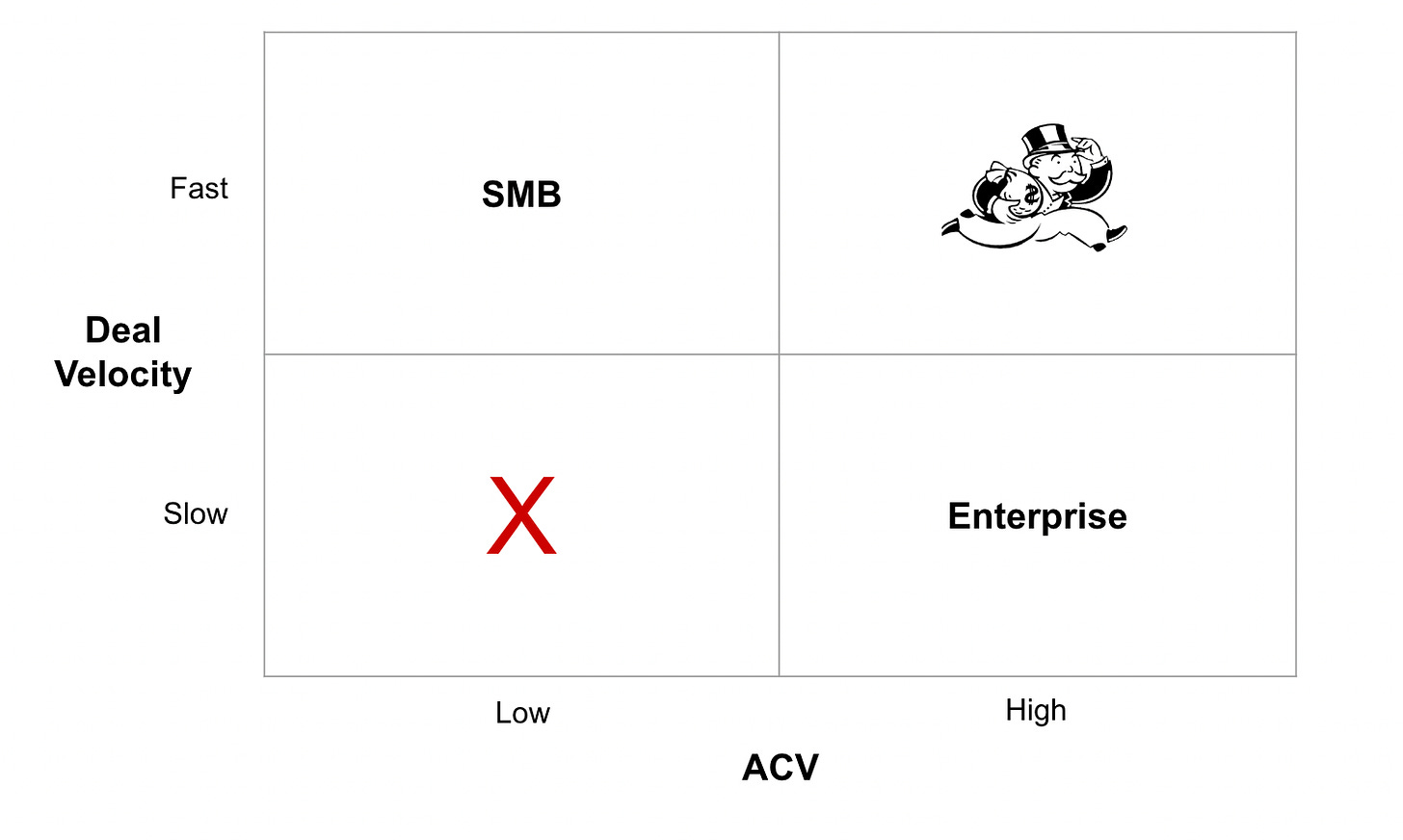
There are four quadrants:
- Bottom right: Sales cycles are long, but they are rewarded with high annual contract values (ACVs). This is the classic Enterprise sales model, which typically involves proactive identification of high-value accounts. Common lead generation strategies include account-based marketing (ABM) and outbound sales.
- Top left: ACV is low, but velocity is high, so lots of small deals add up to a big number. This is the SMB model, or sometimes selling to individual teams within larger companies. This model is usually fueled by product-led growth (PLG) or inbound marketing. Targeting SMBs through outbound sales is challenging due to their sheer number.
- Top right: This rare and coveted quadrant features both high deal sizes and high deal velocity. This exceptional model can occur when a SaaS company has won its category and benefits from order-taking. Or it can be found when a PLG company matures and begins to close enterprise deals. In that case, bottom-up adoption by employees precedes the sale, compressing the sales cycle.
- Bottom left: This is the only quadrant that doesn’t work. Deals are both small and slow. For example, a startup that takes 6 months to close a $25k deal is not sustainable. However, during a startup’s first year, closing $25k enterprise deals is acceptable as a proof of concept (POC). Just understand that a real enterprise deal doesn’t materialize until you renew for at least $100k+/year.
In summary, a low-ACV model can succeed if it has high velocity, and a high-ACV model can afford to have low velocity, but low ACVs with low velocity spell disaster.
Rules of thumb for an acceptable relationship between deal size and cycle time.

How do I get out of the losing quadrant?
Suppose your average deal size doesn’t align with the appropriate cycle time. In that case, you need to focus on moving right (to higher ACVs) or moving up (to quicker sales cycles). Here are some suggestions: